Labradors in general are always very lovable, energetic, and not at all harsh or aggressive. But usually there still is a slight difference between each puppy in a litter. Before even choosing a puppy out of a litter, first you should find a good breeder who should take good care of the litter before they go to their forever homes. It would be best if you can find a breeder who only breeds his dog once a year or once every half a year, so the parents are in good health condition. Also, the parents of the puppies should be relatively young and have good personalities. For healthier puppies, choose a puppy who’s parents are certified in hip, eye, etc.
After you have chosen the breeder, your next task will be choosing the puppy that will become your forever companion. Yes, Labradors are very friendly overall, but there still may be small differences between each puppy in a litter. For example, one puppy may be more solitary than another. Well then… How do you figure out which puppy is your puppy?
Testing, Testing
This test is called the Puppy Temperament Test. It is a simple way of testing the puppy’s attitude and temperament without hurting it. Make sure of a few things before you start:
- The testing is done before the puppies have their next meal.
- You should test the puppies when they are most energetic, not when they have just awakened from a long, drowsy nap.
- If a certain puppy is not feeling well, do not test it, because the results will not be accurate.
- It is best to not have any distractions when you are testing a puppy.
After that, you can officially start your puppy temperament testing!
- Come here, puppy! – Place the puppy about 4-5 feet away from you. Kneel down (don’t lean towards the puppy) and gently call or clap for him/her to come to you (don’t shout!). Don’t make any movement with your arms or body towards the puppy.
- Follow me! – Start walking away from the puppy slowly, and calmly ask for him/her to follow you, and clap occasionally if needed. Don’t start walking away if the puppy does not have his/her full attention on you. Make sure the puppy sees you walking away.
- Belly up! – Go over to the puppy and gently flip him/her over for about 15 seconds so that the puppy’s back is on the ground. Don’t push to hard on the puppy (watch his/her reactions while you are performing the test).
- Petting time! – Kneel beside the puppy as you gently stroke his entire body (head to tail) and see what he/she does to you. Licking you is a sign that the puppy forgives you!
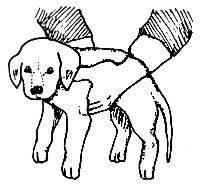
- I’m flying! – Lift the puppy up carefully with both hands, supporting it under its chest and front legs. Hold the puppy there in midair for about 15 seconds. Watch its reaction carefully during the test.
- Go fetch! – Take a piece of paper and crumple it up. Move it around in the air while the puppy watches while showing some interest in the piece of paper. Then, throw it (don’t throw it too far) so that the puppy can get the paper. *Don’t throw the paper ball too far or else the puppy may not be able to find it.
- A little squeeze! – Find the webbing between the puppy’s index finger and thumb and begin pressing on the webbing (start gently), and increase pressure on it as you keep count on how many seconds passed from the start before the puppy showed any signs of struggling or discomfort.
- Look, what’s that? – Take a towel, roll it up, and throw it quickly across the ground (make sure the puppy is watching). *Again, don’t throw it too far.
And… You’re done! Now it’s time to score the puppies!
Scoring
Come here, puppy!
Score 1 – The puppy comes towards you, paws a bit, and tries to bite your hands.
Score 2 – The puppy comes towards you, paws a bit, and gives your hands a lick.
Score 3 – The puppy comes towards you with their tail up.
Score 4 – The puppy comes towards you with their tail down.
Score 5 – The puppy nervously comes towards you with their tail down.
Score 6 – The puppy doesn’t come at all.
Follow me!
Score 1 – The puppy follows you with his/her tail up and tries to bite your feet.
Score 2 – The puppy follows you with his/her tail up and walks and plays around your feet.
Score 3 – The puppy follows you with his/her tail up.
Score 4 – The puppy follows you with his/her tail down.
Score 5 – The puppy follows you nervously with his/her tail down.
Score 6 – The puppy doesn’t follow you.
Belly Up!
Score 1 – The puppy struggled a lot, moved his/her paws, and tried to bite you.
Score 2 – The puppy struggled a lot and moved his/her paws.
Score 3 – The puppy struggled a bit, then settled while making a bit of eye contact.
Score 4 – The puppy struggled a bit and then settled.
Score 5 – The puppy didn’t struggle at all.
Score 6 – The puppy didn’t struggle and tried avoiding any possible eye contact.
Petting Time
Score 1 – The puppy pawed at the ground, tried to bite you, and growled a bit.
Score 2 – The puppy pawed at the ground.
Score 3 – The puppy crawls on to you and tries to lick your face.
Score 4 – The puppy moves around and tries to lick your hands and arms.
Score 5 – The puppy rolls over and tries to lick your hands and arms.
Score 6 – The puppy walks away.
I’m Flying!
Score 1 – The puppy struggles a lot and attempts to bite you.
Score 2 – The puppy struggles a lot.
Score 3 – The puppy alternated between struggling and not struggling.
Score 4 – The puppy didn’t struggle and was very relaxed.
Score 5 – The puppy didn’t struggle, but his/her body was tense.
Score 6 – The puppy didn’t struggle and did not move at all (also very tense).
Go Fetch!
Score 1 – The puppy ran after the paper, picked it up, and ran off.
Score 2 – The puppy ran after the paper, looked at it, and didn’t come back.
Score 3 – The puppy ran after the paper, picked it up, and came back.
Score 4 – The puppy ran after the paper, did not pick it up, and came back.
Score 5 – The puppy ran halfway to the paper and stopped.
Score 6 – The puppy did not chase the paper.
A Little Squeeze!
Score 1 – You counted to about 8-10 seconds before the puppy showed a response.
Score 2 – You counted to about 6-8 seconds before the puppy showed a response.
Score 3 – You counted to about 5-6 seconds before the puppy showed a response.
Score 4 – You counted to about 3-5 seconds before the puppy showed a response.
Score 5 – You counted to about 2-3 seconds before the puppy showed a response.
Score 6 – You counted to about 1-2 seconds before the puppy showed a response.
Look, What’s That?
Score 1 – The puppy ran to the towel, clawed and attacked it, and tried to bite it.
Score 2 – The puppy ran to the towel, stepped on it, and mouthed on it.
Score 3 – The puppy went to the towel and looked curiously at it with his/her tail up.
Score 4 – The puppy observed the towel with his/her tail down.
Score 5 – The puppy was startled and hid behind you.
Score 6 – The puppy hid behind you.
THE FINAL RESULTS/SCORES
If the majority of the scores are 1’s:
- Strong desire to become alpha (leader).
- Will attack, bite, and bark if he wants to.
- Don’t buy this puppy if you are a first time dog owner (even if he is quite adorable)!
If the majority of the scores are 2’s:
- Strong self confidence and strives to be leader as well.
- Also may bite or bark.
- This puppy may be hard to raise properly if you are a first time dog owner.
If the majority of the scores are 3’s:
- This puppy is a quick learner!
- May be a bit troublesome at times.
- Will be very energetic at times.
If the majority of the scores are 4’s:
- May be the best puppy for a first time dog owner.
- Does not need to be alpha in the pack.
- A good, trainable dog with a personality leaning more towards the quiet side.
- Very suitable dog for elderly people.
If the majority of the scores are 5’s:
- Startled and scared by sudden movements or noises.
- A different surrounding may upset/scare the puppy.
- Will back down at anything that it thinks it cannot handle.
- Has a lot of fear.
- Extremely quiet.
If the majority of the scores are 6’s:
- This puppy does not think that he/she needs you in his/her life.
- Very independent and solitary.
- Does not feel the need to become friends with his/her owner.
Choose the dog that you think you can handle and best fits your personality!
References used:
http://www.volhard.com/pages/pat.php